Why Choose Integrated LED Office Lights for a Long Lifespan?

Time:2026-09-19 Author:Ethan
0%

Choosing integrated LED office lights is more than selecting a modern ceiling fixture. It is a practical decision about maintenance, energy use, and workplace reliability. In a busy office, replacing lamps can interrupt meetings, require ladders, and leave desks in uneven light. An integrated design places the LEDs and driver inside one coordinated unit. This can create a cleaner appearance and more consistent illumination across workstations.

A common question is, “what is the lifespan of an integrated led office light?” Many products are rated for 50,000 hours, but this figure is not a promise of identical performance in every building. Lifespan depends on driver quality, operating temperature, daily usage, and ventilation above the ceiling. A light running ten hours daily could approach its rated period after many years. Heat matters. A poorly ventilated fixture may age faster than its specification suggests.

Professional manufacturers usually support claims with recognized testing methods, such as LM-80 data for LED packages and TM-21 projections. Still, ratings can feel abstract. A facility manager sees real evidence in stable brightness, low failure rates, and fewer service visits. The best fixtures also provide suitable color temperature, glare control, and replaceable components where practical. Integrated lights are not automatically perfect. If the driver fails, servicing the complete fixture may be less convenient than changing a lamp. That limitation deserves attention. A careful buyer should review warranty terms, thermal design, test reports, and expected maintenance conditions before choosing. The longest lifespan is useful only when the light remains comfortable, efficient, and dependable.
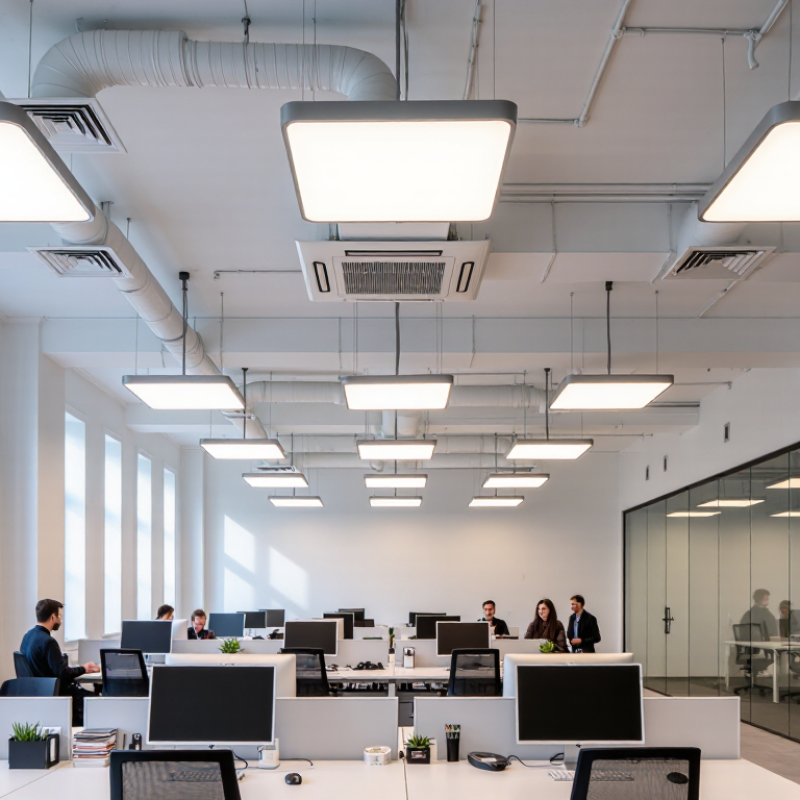
Why Choose Integrated LED Office Lights for a Long Lifespan?

What Integrated LED Office Lights Are

Integrated LED office lights are fixtures with LED chips, a driver, and heat-management parts built into one housing. They do not use a separate replaceable bulb. The light source sits behind a diffuser, often a flat panel or linear lens, creating a clean ceiling profile.

In office projects I have reviewed, this design simplifies installation and reduces loose components above the ceiling. A quality fixture spreads heat through its metal body, because excessive heat can shorten LED performance. The driver also controls electrical current and influences flicker, dimming, and operating stability. Look for clear specifications, including color temperature, color rendering, rated lifetime, and warranty terms.

A long lifespan is useful, but it is not automatic. Rated hours usually describe controlled testing, not every dusty meeting room or hot ceiling space. Dust buildup, poor ventilation, frequent switching, and unstable electrical conditions can change real-world results. That assumption needs checking. I once saw a well-rated fixture perform poorly because its driver overheated in a tightly enclosed ceiling. Integrated lights can reduce lamp replacement work, yet repairs may require replacing the entire fixture or its internal module. For facility teams, the practical choice depends on access, maintenance plans, light quality, and total operating cost. There is no perfect fixture.

How Integrated LED Technology Extends Fixture Lifespan

Why Choose Integrated LED Office Lights for a Long Lifespan?

How Integrated LED Technology Extends Fixture Lifespan

Integrated LED technology places the light source, board, optics, and driver within one engineered fixture. This arrangement removes many sockets, lamp contacts, and replaceable joints that can loosen over time. Fewer connection points mean fewer opportunities for flicker, corrosion, or accidental damage during maintenance. In a busy office, that matters. A ceiling grid stays quieter.

Heat is the real test. Quality fixtures use aluminum paths, suitable housings, and carefully matched drivers to move heat away from the LED board. Lower operating temperatures slow lumen depreciation and protect electronic components. Stable drivers also reduce stress during frequent switching or occupancy-sensor cycles. The result is more consistent light across desks, corridors, and meeting rooms.

The promise is not absolute. Not always. Dust, excessive heat, unstable voltage, or poor installation can shorten service life quickly. I have seen long-life fixtures fail early when insulation covered the housing or wiring was overtightened. That detail is easy to miss. Selecting suitable temperature ratings, leaving ventilation clear, and checking driver quality are practical safeguards. Integrated construction can extend fixture life, but the entire installation still needs careful attention.

Key Components That Support Long-Term Performance

Integrated LED office lights are only as durable as their supporting components. The LEDs may promise long service, but the driver often determines real-world survival. The U.S. Department of Energy reports that quality LED products can use at least 75% less energy. They can also last up to 25 times longer than incandescent lamps. That statistic is useful, but not absolute. Heat, voltage variation, and crowded ceilings can shorten performance.

A dependable fixture needs a thermally efficient aluminum housing. It moves heat away from the LED board and driver. Lower operating temperatures help preserve light output and electronic components. Photometric testing commonly reports L70 life, meaning projected output remains at 70% of initial lumens. A 50,000-hour rating sounds impressive. It equals roughly 11 years at 12 hours daily. Still, L70 does not guarantee that the driver, diffuser, or controls will last equally long.

Look for LM-80 measurements and TM-21 projections, referenced by the Illuminating Engineering Society. These methods separate measured lumen maintenance from optimistic marketing claims. Surge protection, replaceable drivers, sealed wiring, and stable dimming controls also support long-term performance. The DesignLights Consortium’s technical requirements emphasize tested efficacy and controllability for commercial lighting. In practice, inspect a sample after several months. Flicker, buzzing, yellowed lenses, or uneven brightness can reveal weaknesses early. I would not choose solely by rated hours. Maintenance access matters. So does the ceiling environment. A slightly lower-output fixture with better thermal design may serve an office longer.

Energy Efficiency and Reduced Maintenance Requirements

Why Choose Integrated LED Office Lights for a Long Lifespan?

Energy Efficiency and Reduced Maintenance Requirements

Integrated LED office lights reduce energy use without relying on frequent lamp replacements. The U.S. Department of Energy reports that LEDs use at least 75% less energy than incandescent lighting. They can also last up to 25 times longer. In a busy office, this difference becomes visible on monthly utility bills and maintenance schedules.

A typical ceiling fixture operates for many hours each weekday. With integrated LEDs, staff may avoid storing replacement tubes and arranging ladder access. That matters in corridors, meeting rooms, and high ceilings. The International Energy Agency identifies lighting as a major global electricity user, so small efficiency gains can create meaningful demand reductions. Lower heat output may also reduce cooling pressure during summer.

The calculation is not perfect. An integrated fixture often requires replacing the whole unit when its driver fails. That can increase electronic waste and installation costs. The U.S. Department of Energy notes that LED performance depends on thermal management, controls, and product quality. A poorly ventilated ceiling can shorten service life. Check heat ratings, warranty terms, and expected operating hours before choosing. Not every low-cost fixture is a long-term saving. A maintenance log helps reveal the truth.

Why Choose Integrated LED Office Lights for a Long Lifespan? - Energy Efficiency and Reduced Maintenance Requirements

Performance Dimension Integrated LED Office Light Conventional Fluorescent Office Fixture
Typical electrical power for approximately 4,000–5,000 lumens 30–40 W 50–70 W, including ballast losses
Typical system efficacy Approximately 100–150 lumens per watt Approximately 70–100 lumens per watt
Rated operating life Typically 50,000–100,000 hours, depending on design and operating conditions Typically 20,000–30,000 hours for common linear fluorescent lamps
Annual electricity use per fixture About 120 kWh at 40 W and 3,000 operating hours per year About 192 kWh at 64 W and 3,000 operating hours per year
Potential electricity reduction Approximately 72 kWh less per fixture each year, or about 37.5% compared with a 64 W fluorescent fixture Used as the comparison baseline
Replacement frequency over 15 years at 3,000 hours per year Usually no scheduled light-source replacement; replacement depends on the product’s rated life and condition Approximately 1–2 lamp replacement cycles, depending on lamp life and operating conditions
Maintenance requirements Lower routine maintenance because there are no separate fluorescent tubes or starters to replace Periodic tube, starter, or ballast maintenance may be required
Light-output depreciation Typically specified using an L-rating, such as L70, indicating the time until output reaches 70% of initial lumens Output can decline through lamp aging, blackening, dirt accumulation, and ballast performance changes
Control compatibility Often compatible with dimming, occupancy sensors, daylight controls, and scheduling when specified with suitable drivers Control performance varies and may require compatible dimming ballasts or control equipment
Environmental considerations Contains no mercury in the light source and generally produces less energy-related carbon emissions when using less electricity Fluorescent lamps contain mercury and require appropriate recycling or disposal procedures

Notes: Values are typical industry ranges for office lighting and are provided for comparison. Actual performance depends on fixture design, operating temperature, controls, installation conditions, cleaning practices, electricity rates, and local operating schedules. Annual energy calculations use 3,000 operating hours and exclude HVAC savings.

Factors to Consider When Selecting Integrated LED Office Lights

Why Choose Integrated LED Office Lights for a Long Lifespan?

Selecting integrated LED office lights requires more than checking wattage. The U.S. Department of Energy reports that quality LEDs use at least 75% less energy than incandescent lamps. They can also last up to 25 times longer. However, these figures do not guarantee performance in every office. Review the rated life, L70 value, and operating temperature. A 50,000-hour label may describe the LED package, not the complete fixture.

Thermal management deserves close attention. Heat trapped above a ceiling can shorten the life of the LED driver and circuit board. Look for aluminum heat paths, suitable ventilation, and tested performance at realistic ambient temperatures. IES LM-80 and TM-21 provide recognized methods for evaluating LED lumen maintenance. Still, projected data can feel cleaner than real-world conditions. Dust, voltage changes, and frequent switching may alter results.

Light quality affects daily comfort. Choose a suitable color temperature, often 3500K or 4000K for offices, with a CRI of 80 or higher. Check glare ratings, especially above desks and video-call areas. Flicker performance also matters; IEEE 1789 offers guidance for reducing health risks linked with temporal light modulation. Controls can reduce operating hours, but compatibility must be tested before installation. Integrated designs often look neat and reduce lamp replacements. Their weakness is less obvious: when the driver fails, replacing the whole fixture may be expensive. A clear driver warranty and accessible service plan are essential.

Why Choose Integrated LED Office Lights for a Long Lifespan?

Typical rated service life varies significantly by light source. Integrated LED office lights can provide approximately 50,000 hours of rated life, reducing relamping frequency and maintenance interruptions compared with conventional alternatives.

Values represent commonly published typical rated-life figures: incandescent lamps around 1,000 hours, T8 fluorescent lamps around 15,000 hours, and integrated LED systems around 50,000 hours. Actual performance depends on temperature, driver quality, operating hours, and installation conditions.

FAQS

What are integrated LED office lights?

They combine LED chips, a driver, and heat-management parts in one housing. The light sits behind a flat diffuser or linear lens. No separate bulb is used.

Why do offices use integrated LED fixtures?

They create a clean ceiling profile and reduce loose parts above the ceiling. Installation can be simpler. Lamp replacement work may also decrease.

Which component most affects long-term performance?

The driver often determines real-world survival. It controls current, dimming, flicker, and operating stability. A weak driver can fail before the LEDs.

How does heat affect an integrated LED light?

Heat can shorten LED and driver performance. An aluminum housing helps move heat away from internal parts. Crowded, poorly ventilated ceilings are risky.

Does a 50,000-hour rating guarantee eleven years of service?

No. That estimate assumes roughly twelve hours of daily use under controlled conditions. Dust, voltage changes, heat, and switching habits can reduce actual performance.

What does an L70 rating mean?

L70 usually means projected light output remains at 70% of its starting level. It does not guarantee that the driver, diffuser, or controls last equally long.

What specifications should buyers compare?

Check color temperature, color rendering, rated lifetime, warranty terms, efficacy, dimming behavior, and surge protection. Verified testing is more useful than a large hour number alone.

What problems can appear after installation?

Flicker, buzzing, yellowed lenses, and uneven brightness may appear early. Inspecting a sample after several months can reveal weaknesses. I would not trust the label blindly.

Conclusion

Integrated LED office lights combine the LEDs, optics, driver, and housing into one coordinated fixture rather than relying on replaceable bulbs. This design improves light distribution, reduces connection points, and helps protect internal components from vibration, dust, and everyday office use. By using efficient LED technology and carefully matched electrical components, the fixture can maintain consistent brightness for many years while producing less heat than traditional lighting systems. If you ask, “what is the lifespan of an integrated led office light,” the answer depends on product quality, operating hours, ventilation, and environmental conditions, but many are designed for long-term service with significantly reduced replacement needs.

Their energy efficiency can lower electricity consumption, while the absence of frequent lamp changes reduces maintenance time, labor, and disposal requirements. When selecting an integrated LED office light, consider rated life, lumen output, color temperature, glare control, dimming compatibility, warranty coverage, thermal management, and suitability for the room’s ceiling and work activities. A thoughtful choice can support comfortable illumination, dependable performance, and lower ownership costs over the life of the installation.

Ethan

Ethan

Ethan is a seasoned marketing professional with a deep expertise in our company's innovative product line. With a passion for sharing knowledge and insights, he takes the lead in regularly updating our corporate blog, where he explores industry trends, product features, and effective marketing......